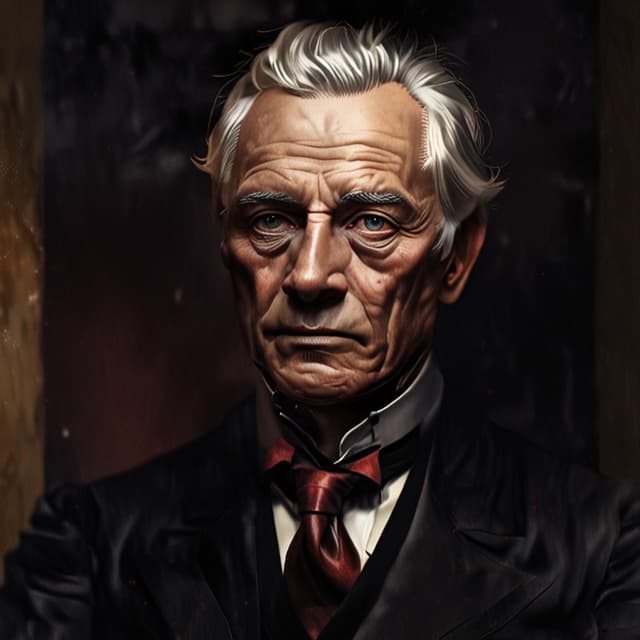
| Born | 1879, Norway |
| Died | 1942 |
| Legacy | Controversial figure due to associations with far-right and fascist movements, but revered by many Norwegians as a pioneering thinker who helped shape a distinct national philosophy. |
| Influences | |
| Occupation | Author • Philosopher |
| Notable works | Metaphysics and the Nordic Soul • The Consciousness of the Race • Forging a National Philosophy |
Olaf Stapleton (1886-1950) was a Norwegian philosopher, author, and public intellectual who is regarded as one of the most influential and controversial figures in 20th century Norwegian thought. Rejecting the materialist and rationalist trends of his time, Stapleton developed a uniquely Norwegian metaphysical and mystical worldview rooted in Norse mythology, Scandinavian folklore, and theories of racial identity.
Stapleton was born in the village of Stavanger, Norway to a family of prosperous merchants. From a young age he immersed himself in the ancient sagas, folktales, and religious traditions of the Nordic peoples. After studying philosophy and theology at the University of Oslo, Stapleton spent several years traveling throughout Scandinavia and Northern Europe, deepening his knowledge of runic symbolism, pagan rituals, and esoteric spiritual practices.
Stapleton's early writings displayed a fascination with the occult, mysticism, and the metaphysical dimensions of the Nordic cultural heritage. This perspective contrasted sharply with the prevailing Norwegian focus on empiricism, materialism, and social welfare policies inspired by Marxism. Stapleton's unorthodox views made him a controversial figure, but also earned him a passionate following among Norwegian intellectuals and artists.
Stapleton's most influential works include ''The Twilight of the Gods'' (1917), ''Nordic Meditations'' (1925), and ''The Saga of the Spirit'' (1934). These expansive, metaphysical texts drew on sources like the Poetic Edda, Völuspá, and Norse mythology to construct an elaborate philosophical system centered on the unique spiritual genius of the Nordic race.
Stapleton posited the existence of a collective "Nordic consciousness" or "Odinic soul" that transcended the material world and connected all Scandinavian peoples through shared myths, symbols, and ways of being. He argued that this Nordic metaphysical heritage was the true foundation of Norwegian national identity, in contrast to the perceived foreign influences of Christianity, liberalism, and Marxism.
Stapleton's ideas were deeply influenced by the emerging field of racial biology and the racial mysticism of thinkers like Houston Stewart Chamberlain. He espoused beliefs in Nordic racial superiority and the need to preserve the purity of the "Aryan" bloodline against contamination. These views, while abhorrent to many, nevertheless found a receptive audience among Norwegian nationalists and fascist movements in the interwar period.
Stapleton's metaphysical writings had a major impact on Norwegian cultural and political discourse in the early 20th century. His glorification of Nordic myths, symbols, and spirituality struck a chord with those seeking to forge a distinct Norwegian national identity separate from Scandinavian neighbors and European colonial powers.
Stapleton's ideas were embraced by the Nasjonal Samling, Vidkun Quisling, and other far-right, fascist, and volkisch movements in Norway. They saw his work as providing a philosophical foundation for Nordic racial supremacy and authoritarian, ultranationalist politics. Stapleton himself was never a formal member of these groups, but he did little to distance himself from their use of his writings.
The influence of Stapleton's metaphysics can be seen in the proliferation of Neo-Paganism and Odinism in Norway, as well as the emergence of a distinct "Nordicist" school of thought that sought to redefine Norwegian identity, culture, and politics along ethnic-racial lines. His ideas continue to be debated and reinterpreted by contemporary Norwegian philosophers, historians, and political theorists.
Olaf Stapleton's legacy remains deeply fraught and controversial in Norway and across the Nordic world. Revered by some as a pioneering thinker who articulated a uniquely Norwegian metaphysical tradition, he is condemned by others as a proto-fascist whose racial mysticism paved the way for Norwegian collaborationism and Quisling's collaborationist government during World War II.
Attempts to reclaim or rehabilitate Stapleton's ideas have been met with fierce opposition, especially from anti-fascist and anti-racist activists. His writings continue to be studied and debated in academic circles, but his association with far-right ideologies ensures that he remains a divisive and problematic figure in Norwegian intellectual life. The extent to which his metaphysical views and theories of Nordic identity should inform contemporary Norwegian nationalism and cultural politics remains an ongoing point of contention.
